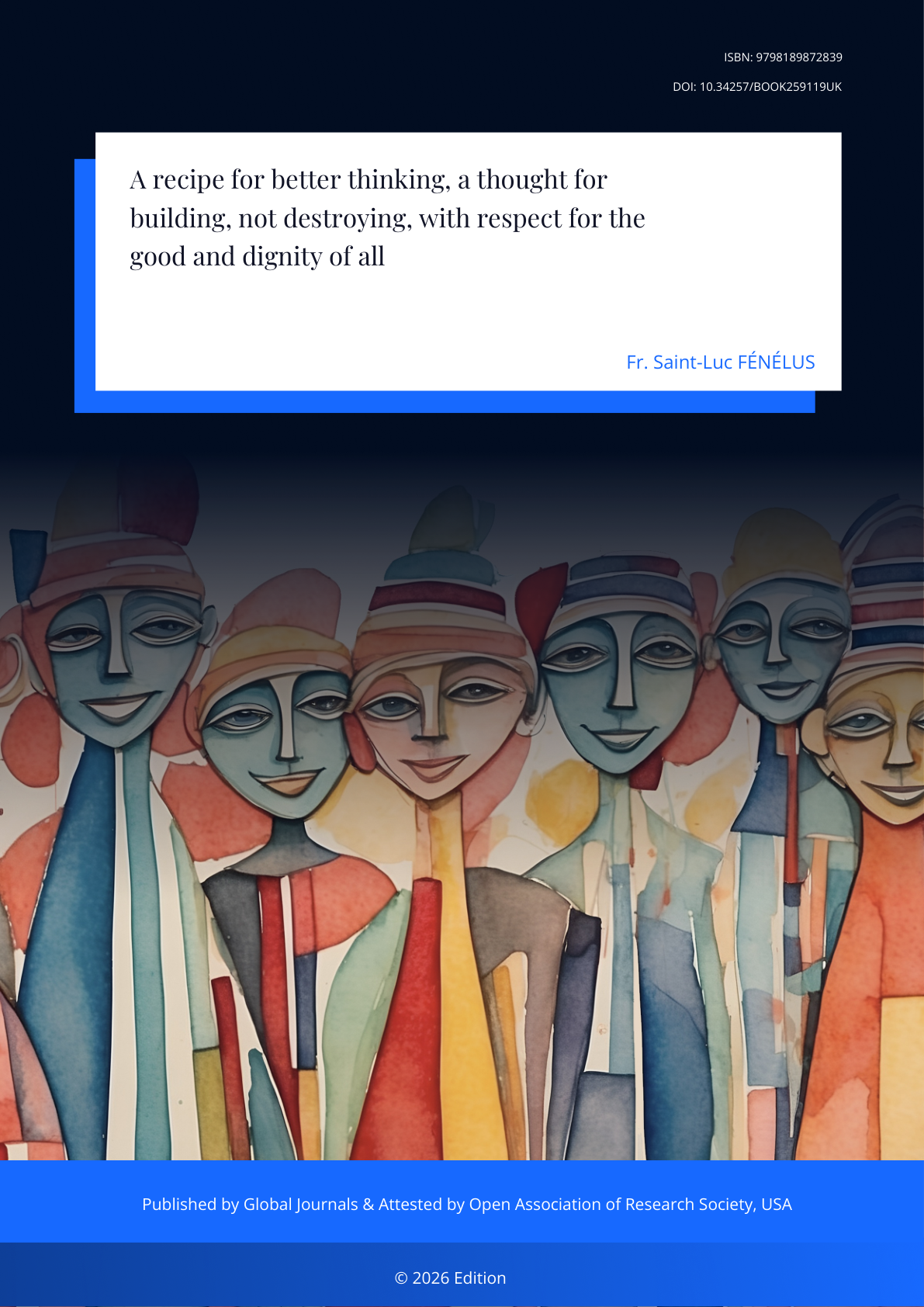
A recipe for better thinking, a thought for building, not destroying, with respect for the good and dignity of all

A recipe for better thinking, a thought for building, not destroying, with respect for the good and dignity of all

Authors

Fr. Saint-Luc FÉNÉLUS
Published August 3, 2026
E-ISBN 9798189872839
Pages257
LanguageEnglish

Keywords

Synopsis

Author Biography

Fr. Saint-Luc FÉNÉLUS

Fr. Saint-Luc FÉNÉLUS

Father Saint-Luc Fénélus: Elementary school: 1984–1993 in Puilboreau and Ennery. High school: 1993–2000 in Ennery and Gonaïves (CDSP). Philosophy Studies: 2001–2004 in Cessades, Haiti (Bachelor’s degree), affiliated with the Pontifical Salesian University (PUS) in Rome. Community Experience: 2000–2008 in Haiti and Ecuador. Theological Studies: 2004–2008: Bachelor’s degree at CEIT, at the Convent of the Dominican Fathers, OP, in the Dominican Republic, affiliated with the Pontifical University of St. Thomas Aquinas “Angelicum” in Rome, and Licentiate in Theology from the Pontifical Catholic University of Ecuador (PUCE), 2010–2013. Ordination: Diaconate: August 15, 2014; Priesthood: December 12, 2014, in the Archdiocese of Joinville, Santa Catalina, Brazil. Continuing Education: 2017–present: Master’s degree in Canon and Civil Law from the Pontifical Lateran University (PUL) in Rome (in civil and religious law), and currently pursuing a doctorate at the same university (in civil and religious law). Graduated with a degree in Advanced Studies for the Causes of Saints from the Institutum Patristicum Agustinianum – PUL and the Dicastery for the Causes of Saints in 2024–2025, he received a certificate in the course on exorcism from the Pontifical Athenaeum Regina Apostolorum (APRA) in 2025 and completed the training course in bioethics at APRA in Rome in 2024–2025. A graduate of CEBIPAL and the Centrality Program for the Protection of Children and Youth (PCN), an organization established by the Latin American Episcopal Conference (CELAM), Caritas Latin America, Fe y Alegría, World Vision, and other socio-ecclesial organizations, whose goal is to train agents of kindness and well-being as part of the continental strategy for the prevention and protection of children and adolescents, with the support of Intermissionwerk, in 2021. He was also a graduate of the schools of the Academy of Catholic Leaders between 2019 and 2021. He received certificates from the Faculty of St. Basil the Great (FASBAM) in Brazil for courses on the formation of priests and formators of consecrated life, on Mariology and the role of philosophy in ecclesial formation, and for seminars on canon law in 2020–2021. He participated in and received a certificate from the International Congress on the Protection of Minors and Vulnerable Persons at PUC Goiás in 2020. He also participated in and received a certificate from the alumni reunion of the Ribeirão Preto Law School/USP at the University of São Paulo in Brazil in 2020. He also participated in the 3rd Canon Law Symposium of the Higher Institute of Canon Law of Santa Catarina on “The Management of Ecclesiastical Assets in Light of the Brazil-Holy See Agreement: Problems and Perspectives” in 2019 and received a certificate. He participated in and received a certificate from the Brazilian Communication Workshop in 2021. He also participated in and received a certificate from the conference on the Second Vatican Council and its implications at the Pontifical Catholic University of Ecuador (PUCE) in 2012, as well as from the UFFS seminar on international migration and the 1st meeting/ conference of PROHAITI’s institutional commissions on the historical and political dimensions of recent migration in Brazil in 2022, and the 33rd meeting/conference of the Brazilian Society of Canonists in Joinville on marriage—updates—theological, canonical, and pastoral aspects in 2018. He is currently pursuing a master’s degree in Bioethics at Anáhuac University (Mexico). This master’s program is recognized and eligible for specific degrees by the following three institutions: the Pontifical Athenaeum Regina Apostolorum (Italy), Francisco de Vitoria University (Spain), and the UNESCO Organization for Bioethics and Human Rights (Italy). Course on Jurisprudence and Administrative Practice of Justice in the Church in 2026, organized by PUL and the Supreme Tribunal of the Apostolic Signatura, with a diploma. Pastoral Experience: In all the countries where I studied, I worked in parishes; I served at UPAG in Haiti, in schools in other countries, and at an ecclesiastical tribunal in Brazil.

Academic Disclosures

Conflict of Interest

The authors declare no conflict of interest.

Data Availability

Not applicable for this article.

Acknowledgement

The author expresses gratitude to God, family members, friends, colleagues, teachers, benefactors, mentors, and supporters whose encouragement, guidance, values, and companionship sustained the work and its ethical-spiritual purpose.

AI Use Disclosure

No generative AI was used for analysis or results,
No statement was found indicating that AI was used to write the book manuscript.

Trial Registration

Not applicable for this article.

Funding

No external funding was declared for this work

References

Adams, J. L. (1965). Paul Tillich’s Philosophy of Culture, Science and Religion. Harper.
Affergan. (1993). Elements for an Anthropological Theory of Relational Universalism. In Universalism and Relativism: Contributions to a Current Debate. University Press.
Aion. Studies on the Symbolism of the Self. (1951).
Aman, M. (2025). An ontology of human origins. International Journal for Philosophy of Religion, 99(1).
Andler, D. (2006). Philosophy of Cognitive Science. In Handbook of the Philosophy of Science. Springer.
Arendt, H. (1978). The Life of the Mind. PUF.
Aristotle. (n.d.). De Anima, III.
Aristotle. (n.d.). Metaphysics.
Aristotle. (n.d.). Nicomachean Ethics.
Aristotle. (1953). Metaphysics (trans. J. Tricot). Vrin.
Aristotle. (1993). On the Soul. GF-Flammarion.
Aristotle. (1993). Politics (trans. J. Tricot). Vrin.
Aristotle. (2014). Complete Works (ed. Pierre Pellegrin). Flammarion.
Artaud, A. (1974). Aux marges de la culture indienne. In Oeuvres complètes (Vol. XII). Gallimard.
Atterton, P., Calarco, M., & Friedman, M. (2004). Levinas and Buber: Dialogue and Difference. Duquesne University Press.
Bachelard, G. (1938). The Formation of the Scientific Mind. Vrin.
Badiou, A. (2015). The Seminar. Heidegger Being 3 — Figure of Withdrawal. Fayard.
Balthasar, H. U. von. (1986). Man in the Image of God. Cerf.
Barberousse, A., & Ludwig, P. (2000). Modèles de fictions (Models of Fiction). Philosophy, 68.
Baudart, A. (1998). History of Philosophy. Founding Thoughts. Armand Colin.
Beauvoir, S. de. (1949). The Second Sex. Gallimard.
Benedict XVI. (2009). Encyclical Letter Caritas in Veritate. In AAS 101 (pp. 641-709). Vatican.
Bimbenet, E. (2011). The Animal I Am No Longer. Gallimard.
Bloch, E. (1976). The Principle of Hope. Gallimard.
Boethius, A. M. S. (1973). De persona et duabus naturis. Harvard University Press (Loeb Classical Library).
Boff, L. (1997). Cry of the Earth, Cry of the Poor. Orbis Books.
Bout. (2001). L’ontologie husserlienne du monde du quotidien. In Phénoménologie et sociologie. PUF.
Buber, M. (1923). Ich und Du. Insel Verlag.
Cassirer, E. (1975). An Essay on Man. Minuit.
Cassirer, E. (1977). Substance and Function: Elements for a Theory of the Concept. Editions de Minuit.
Cassirer, E. (2001). Freedom and Form: The Idea of German Culture. Editions du Cerf.
Castoriadis, C. (1975). The Imaginary Institution of Society. Seuil.
Changeux, J. P. (1983). L’homme neuronal. Fayard.
Chauviré. (1981). Verify or Falsify: From Peirce to Popper. Philosophical Studies, 3.
Clark, A. (2008). Supersizing the Mind. Oxford University Press.
Code of Canon Law. (1983). Libreria Editrice Vaticana.
Condorcet. (1792). Five Memoirs on Public Education.
Congar, Y. (1967). Man and His Destiny According to the Christian Faith. Cerf.
Damasio, A. (1994). Descartes’ Error. Odile Jacob.
Dastur, F. (2009). The Philosophical Question of Finitude. Cahiers de Gestalt-Therapie, 23.
Davies, P. (1992). The Mind of God. Simon and Schuster.
De Lubac, H. (1962). The Religious Thought of Teilhard de Chardin. Aubier.
De Waal, F. (2013). The Bonobo and the Atheist: In Search of Humanism Among the Primates. W. W. Norton and Company.
Descartes, R. (1637). Discourse on Method.
Descartes, R. (1641). Meditations on First Philosophy.
Develay, M. (2003). From Learning to Teaching. ESF.
Devereux. (1980). From Anxiety to Method in the Behavioral Sciences. Flammarion.
Dewey, J. (1910). How We Think.
Dewey, J. (1916). Democracy and Education.
Diesel. (2001). The Animal Origins of Culture. Flammarion.
Durkheim, E. (1922). Education and Sociology. PUF.
Floridi, L. (2014). The Fourth Revolution: How the Infosphere Is Reshaping Human Reality. Oxford University Press.
Foucault, M. (1984). The History of Sexuality, III: The Care of the Self. Gallimard.
Foucault, M. (2001). The Hermeneutics of the Subject. Lectures at the College de France (1981-1982). Gallimard/Seuil.
Frankl, V. (1959). Man’s Search for Meaning. Beacon Press.
Freire, P. (1974). Pedagogy of the Oppressed. Maspero.
Gadamer, H. (1991). The Art of Understanding. Writings II. Hermeneutics and the Field of Human Experience. Aubier.
Galileo. (1623). Il Saggiatore.
Gazzaniga, M. S. (1985). The Social Brain: Discovering the Networks of the Mind. Basic Books.
Girard, R. (1972). Violence and the Sacred. Grasset.
Goldmann. (1959). The Hidden God. Gallimard.
Grondin, J. (1987). The Turning Point in Martin Heidegger’s Thought. Presses Universitaires de France.
Gupta, A., & Ferguson, J. (1997). Culture. Energy. Place. Explorations in Critical Anthropology. Duke University Press.
Habermas, J. (2001). The Future of Human Nature. Toward a Liberal Eugenics? Suhrkamp.
Harari, Y. N. (2014). Sapiens: A Brief History of Humankind. Harper.
Hegel, G. W. F. (1991). Phenomenology of Spirit. Aubier.
Heidegger, M. (1927). Sein und Zeit (Being and Time). Niemeyer.
Heidegger, M. (1950). Paths That Lead Nowhere. Gallimard.
Heidegger, M. (1959). What Is Called Thinking? PUF.
Heidegger, M. (1990). Being and Time. Gallimard.
Heidegger, M. (2003). Contribution to Philosophy: On Coming-At-Hand. Gallimard.
Heraclitus. (1986). Fragments. Presses universitaires de France.
Housset, E. (2002). L’acte de la personnalite selon saint Thomas d’Aquin. Cadmos.
Humboldt, W. von. (1836). On the Diversity of Human Language Structure and Its Influence on the Intellectual Development of the Human Race.
Husserl, E. (1950). Ideas for a Phenomenology. Gallimard.
Husserl, E. (1976). The Crisis of European Sciences and Transcendental Phenomenology. Gallimard.
Ignatius of Loyola. (1548). Spiritual Exercises.
Jaspers, K. (1932). Philosophy. Springer.
Jewishiewicki. (2001). Pour un pluralisme épistémologique dans les sciences sociales. Annales, LVI(3).
John Paul II. (1979). Redemptor Hominis. Libreria Editrice Vaticana.
Jonas, H. (1990). The Imperative of Responsibility: An Ethics for Technological Civilization. Cerf.
Jung, C. G. (1938). Psychology and Religion.
Jung, C. G. (1946). Psychology of the Transference.
Junger, E. (1973). Approaches, Drugs, and Intoxication. Gallimard.
Kant, E. (1781). Critique of Pure Reason. Presses Universitaires de France.
Kant, I. (1784). What is Enlightenment?
Kant, I. (1985). Foundations of the Metaphysics of Morals (trans. V. Delbos). Vrin.
Klein, N. (2014). This Changes Everything. Simon and Schuster.
Kroeber, A. (1952). The Nature of Culture. The University of Chicago Press.
Lalande, A. (1927). Technical and Critical Vocabulary of Philosophy, Vol. I. PUF.
Lamarque, P. V. (1997). Concise Encyclopedia of Philosophy of Language.
Language, Thought, and Cognitive Sciences: Key Theories and Influences. (2025). BrainApps.
Latour, B. (1991). We Have Never Been Modern. La Découverte.
Lee, S. (2025). Cognitive Science in Philosophy: Understanding the Mind through Interdisciplinary Research. Number Analytics Blog.
Lenoir, F. (2007). Le Christ philosophe. Plon.
Leroi-Gourhan, A. (1965). Gesture and Speech. Albin Michel.
Levinas, E. (1961). Totality and Infinity. Nijhoff.
Levinas, E. (1982). Ethics and Infinity. Fayard.
Lovelock, J. (1979). Gaia: A New Look at Life on Earth. Oxford University Press.
Lévi-Strauss, C. (1988). Near and Far. O. Jacob.
MacIntyre, A. (1988). Whose Justice? Which Rationality? University of Notre Dame Press.
MacIntyre, A. (1999). Dependent Rational Animals: Why Human Beings Need the Virtues. Open Court.
Mandik, P. (2023). Philosophy of Cognitive Science. Oxford Bibliographies.
Marcel, G. (1944). Homo Viator. Aubier.
Marcus Aurelius. (1998). Meditations. GF-Flammarion.
Maritain, J. (1939). Integral Humanism. Aubier.
Maritain, J. (1947). The Person and the Common Good. Desclee de Brouwer.
Maritain, J. (1953). Approaches to God. Fayard.
Merleau-Ponty, M. (1945). Phenomenology of Perception. Gallimard.
Morin, E. (1970). The Lost Paradigm: Human Nature. Seuil.
Morin, E. (2004). The Method. Seuil.
Mounier, E. (1949). Personalism. PUF.
Naess, A. (1989). Ecology, Community and Lifestyle. Cambridge University Press.
Neumann, E. (1974). Ursprungsgeschicht des Bewusstseins 2.
Nietzsche, F. (1968). Thus Spoke Zarathustra. Aubier.
Nussbaum, M. (2010). Not for Profit: Why Democracy Needs the Humanities. Princeton University Press.
Nussbaum, M. C. (2006). Frontiers of Justice: Disability, Nationality, Species Membership. Harvard University Press.
Ogien, A. (1987). Les usages de l’identité (The Uses of Identity). In Vers des sociétés pluriculturelles. Les études comparées et la situation en France. ORSTOM.
Okafor, G. T. (2022). Ontology: The Basis of the Mind-Body Problem. International Journal of Scientific and Management Research, 5(2), 236-248.
Pascal, B. (1844). Pensées et Opuscules. De Cluny.
Pascal, B. (1909). Pensées and Opuscules. BNF.
Pascal, B. (1943). Les Pensées. Seuil.
Pascal, B. (2003). Discourse on the Passions (Spanish edition). Editorial Seneca.
Peirce, C. (1935). Collected Papers, vol. III (Vol. III). Harvard University Press.
Penrose, R. (1989). The Emperor’s New Mind. Oxford University Press.
Philosophy of Mind and Cognitive Science. (2025). University of Sheffield.
Plato. (n.d.). The Republic.
Plato. (n.d.). Theaetetus.
Plato. (1993). Phaedo. GF-Flammarion.
Prasolov, V. I., Grigoriev, S. M., Martynenko, E. V., Shindryaeva, N. N., & Skutelnik, O. A. (2021). John Zizioulas’ concept of the person: a critical appraisal. XLinguae, 14(3), 6.
Rahner, K. (1978). Fundamental Treatise on Faith. Cerf.
Rawls, J. (1971). A Theory of Justice. Harvard University Press.
Rawls, J. (1987). A Theory of Justice. Seuil.
Ricoeur, P. (1955). History and Truth. Seuil.
Ricoeur, P. (1960). The Symbolism of Evil. Aubier.
Ricoeur, P. (1983). Time and Narrative. Seuil.
Ricoeur, P. (1990). Soi-meme comme un autre (Oneself as Another). Seuil.
Ricoeur, P. (2000). Memory, History, Forgetting. Seuil.
Ricoeur, P. (2004). The Course of Recognition. Stock.
Rosenzweig, F. (2003). The Star of Redemption. Seuil.
Samuels, R., Margolis, E., & Stich, S. (2012). Introduction: Philosophy and Cognitive Science. In The Oxford Handbook of Philosophy of Cognitive Science. Oxford University Press.
Sanhedrin 97a, The William Davidson Talmud. (n.d.). https://www.sefaria.org/william-davidson-talmud
Sartre, J.-P. (1943). Being and Nothingness. Gallimard.
Sartre, J.-P. (1946). Existentialism is a Humanism. Nagel.
Schaeffer, J.-M. (2007). The End of the Human Exception. Gallimard.
Scheler, M. (1951). The Position of Man in the Cosmos. Aubier.
Schnell, A. (2005). From Open Existence to Finite World, Heidegger 1925-1930. Vrin.
Schopenhauer, A. (1819). The World as Will and Representation.
Sgreccia, E. (2009). Personalist Bioethics: Foundations and Applications. National Catholic Bioethics Center.
Simondon, G. (1958). On the Mode of Existence of Technical Objects. Aubier.
Soulez, A. (1997). Comment apaiser l’angoisse du philosophe? In Dictées de Wittgenstein à Friedrich Waismann et à Moritz Schlick, vol. II: Études critiques. PUF.
Spaemann, R. (1996). Personen: Versuche uber den Unterschied zwischen etwas und jemand. Klett-Cotta.
Spaemann, R. (2010). Elements of an Ethics of the Person. Cerf.
Spinoza, B. (1677). Ethics, Part V. Gallimard (Pléiade).
Stein, E. (1950). Endliches und ewiges Sein. Herder.
Stein, E. (2025). Endliches und ewiges Sein (Finite and Eternal Being). Herder.
Steinbock, A. (1998). New Contribution to Krisis: A Supplementary Edition of Husserl’s Texts Relating to Krisis. Alter: Monde(s), 6.
Stiegler, B. (1994). Technique and Time. Galilée.
Taran, L. (1965). Parmenides: A Text with Translation, Commentary, and Critical Essays. Princeton University Press.
Teilhard de Chardin, P. (1955). The Human Phenomenon. Seuil.
Thagard, P. (2025). Cognitive Science. Encyclopaedia Britannica.
The Jerusalem Bible. (1998). Cerf.
Thomas Aquinas. (1984). Summa Theologiae. Editions du Cerf.
Thomas Aquinas. (1999). De ente et essentia. Vrin.
Tillich, P. (1963). Systematic Theology, vols. I-III. University of Chicago Press.
Tylor, E. (1876). Primitive Civilization. Reinwald.
Von Rad, G. (1960). Old Testament Theology. Delachaux et Niestle.
Vosgerau, G., & Synofzik, M. (2010). A Cognitive Theory of Thoughts. American Philosophical Quarterly, 47(3), 217-232.
Weil, S. (1947). Gravity and Grace. Plon.
Wheeler, J. A. (1994). At Home in the Universe. American Institute of Physics.
Whitehead, A. N. (1978). Process and Reality. Free Press.
Wittgenstein, L. (1996). The Blue Book and the Brown Book. Gallimard.
Wittgenstein, L. (2004). Philosophical Investigations. Gallimard.
Wojtyla, K. (1983). Person and Act. Le Centurion.
Yrulnik. (1998). If Lions Could Talk: An Essay on the Animal Condition. Gallimard.
Zizioulas, J. (1981). The Ecclesial Being. Cerf.

How to Cite

A recipe for better thinking, a thought for building, not destroying, with respect for the good and dignity of all. (2026). Global Journals. https://doi.org/10.34257/BOOK259119UK

License

Creative Commons Attribution 4.0 International
© 2026 by the author(s). Licensed to Global Journals Organization for publication. This article is distributed under the terms and conditions of the Creative Commons Attribution-NonCommercial-NoDerivatives 4.0 International License (CC BY-NC-ND 4.0), subject to proper attribution. https://creativecommons.org/licenses/by-nc-nd/4.0/